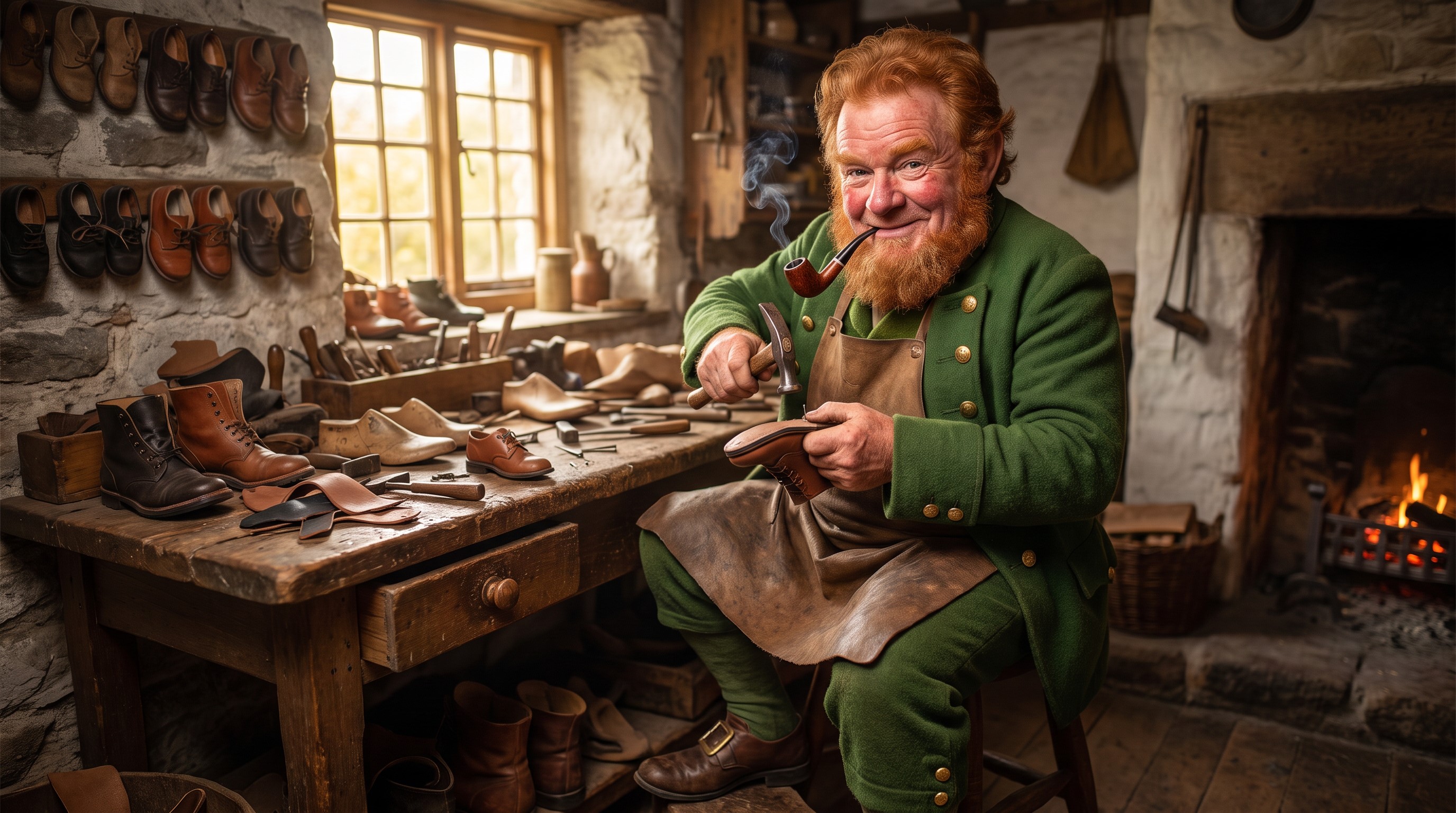
Ask almost anyone, anywhere in the world, to draw something Irish and there's a good chance you'll get a small, bearded man in a green coat and buckled hat, sitting on a pot of gold at the end of a rainbow. He sells breakfast cereal in Ohio, leads a university football team in Indiana, has starred in eight horror films and turns up on paper plates by the million every March.
Very few figures from folklore have travelled this far. The leprechaun is probably the most recognised mythical figure ever to come out of Ireland, more famous abroad than Cú Chulainn, Fionn mac Cumhaill or the Children of Lir put together. So how did a minor, rather grumpy fairy from the Irish countryside become a global brand? And is he really as Irish as we all assume?
Where he came from: a water sprite and a king
The leprechaun is old. The earliest known story featuring him is a medieval tale, Echtra Fergusa maic Léti (The Adventure of Fergus son of Léti), one version of which has been dated to the 8th century. In it, Fergus, a king of Ulster, falls asleep on a beach and wakes to find three small water sprites, lúchorpáin, dragging him into the sea. He grabs them, and they buy their freedom by granting him three wishes.
Hold on to that detail, because it's the whole leprechaun formula in miniature: catch the little man, and he has to give you something. Thirteen centuries later, Disney used exactly the same plot device.
The name itself comes from Old Irish luchorpán, most often explained as lú (small) plus corp (body): "the little body". There's a popular folk explanation that it comes from leith bhróg, "one shoe", because the leprechaun is always found working on a single shoe. It's almost certainly not the real origin, but it's too good a story for anyone to drop.
He wasn't green, and he wasn't jolly
The leprechaun of 19th-century Irish folklore was a very different character from the one on the cereal box. When collectors like Thomas Crofton Croker, Samuel Lover and later W.B. Yeats began writing down rural stories, they described a solitary fairy who lived apart from the "trooping" fairy hosts, and who spent his time making and mending shoes. You found him by following the tap-tap of his tiny hammer.
He was also usually dressed in red. Samuel Lover, writing in 1831, described a little dandy in a red, gold-laced coat and a cocked hat. Yeats drew the distinction neatly: the solitary fairies wore red, while the trooping fairies wore green. In the west, the leprechaun might wear a plain frieze overcoat. The all-green outfit only took over in the 20th century, as Ireland's national colour gradually swallowed him.
Personality-wise, he was clever, crabby, fond of a drink (his cousin the clurichaun is basically a leprechaun on a bender) and, in the words of the 19th-century writer D.R. McAnally, "not wholly good nor wholly evil". If you caught him, he'd promise to lead you to his gold. Take your eyes off him for a second, and he was gone.
So is the leprechaun uniquely Irish?
Yes and no, and the honest answer is more interesting than a simple yes.
The type of creature isn't unique. Almost every corner of northern Europe has a small, solitary, mischievous spirit who lives alongside people, does skilled work and needs careful handling. Scotland has the brownie, Cornwall the piskie, Germany the kobold and the Heinzelmännchen, Scandinavia the nisse and the tomte. The Brothers Grimm even published a story, The Elves and the Shoemaker, about tiny helpers who make shoes overnight.
But the leprechaun himself, with his name, his cobbler's bench, his crock of gold, his wishes and his slippery deals, is Irish through and through. None of his European cousins ever made the jump to global stardom. Ask someone in Chicago, Sydney or Buenos Aires what a kobold is and you'll get a blank look. Ask them about a leprechaun and they'll tell you he's Irish before you finish the question.
So the myth has relatives everywhere, but the brand is uniquely Irish. That makes the real question: why did this one fairy, out of all of them, become world famous?
Reason one: he emigrated with us
Like trad music (see our long read on the session), the leprechaun was built to travel. He needed no shrine, no landscape and no ritual, just a story told at a kitchen table. The millions of Irish people who left during and after the Famine took him with them in their heads.
In America especially, he became shorthand for a home that many emigrants would never see again. A small man with a pot of gold makes a powerful symbol for people who left with nothing and hoped to strike it lucky.
Reason two: the caricature, and then the comeback
There's a darker side to this story. In Victorian Britain and America, the Irish were mercilessly caricatured as drunken, feckless, ape-like and childish. Some historians argue that the stage-Irish leprechaun, small, scheming, comic and forever after money, grew partly out of those stereotypes.
Ireland itself has long been uneasy about him. As far back as 1963, the former Taoiseach John A. Costello publicly criticised tourism advertising that leaned on the leprechaun and similar clichés. Plenty of Irish people still wince at the paddywhackery of plastic hats and "Kiss me, I'm Irish" T-shirts.
Yet over time, Irish-Americans took ownership of the image and turned it from an insult into a badge of pride. When Notre Dame registered its fist-raised "Fighting Irish" leprechaun as an official mascot in 1965, the point was clear: the little man was now a fighter, not a joke.
Reason three: Hollywood, cereal and St Patrick's Day
Then commerce arrived, and it arrived mostly in America:
1947 to 1968, Finian's Rainbow: a Broadway musical about a leprechaun chasing his stolen crock of gold, later filmed by Francis Ford Coppola with Fred Astaire.
1959, Darby O'Gill and the Little People: Disney's film, with a young Sean Connery, in which a leprechaun king grants three wishes. It's Fergus mac Léti's story, 1,200 years on.
1964, Lucky Charms: General Mills launched the cereal with a mascot, Lucky the Leprechaun, and the slogan "They're magically delicious". He has been selling marshmallows to American children ever since.
1993, Leprechaun: a low-budget horror film starring Warwick Davis, with an early role for Jennifer Aniston. It cost under $1 million, earned more than eight times that in cinemas and spawned a long-running franchise.
Every one of these pushed the same green-coated image back out across the world, including back to Ireland.
The biggest engine of all is St Patrick's Day. According to the US National Retail Federation, Americans were expected to spend a record $7.7 billion on the holiday in 2026, up from $7 billion the year before. That's food, drink, decorations, clothes and parties, and the leprechaun is its unofficial face. Nobody publishes a figure for leprechaun merchandise on its own, but when you add the dolls, puppets, costumes, pub signs, books and films worldwide, it's fair to say the little shoemaker sits at the centre of a multi-billion-dollar industry.
Ireland plays along (with a wink)
Ireland has learned to enjoy the joke. In 2010, the National Leprechaun Museum opened on Jervis Street in Dublin. The Irish Times nicknamed it the "Louvre of leprechauns", and it uses the little man as a way in to the much richer world of Irish folklore.
That same year, after an eight-year campaign by locals in Carlingford, Co. Louth, the Cooley Mountains around Sliabh Foy were declared a protected area under the EU Habitats Directive. The campaigners cheerfully pointed out it was home to Ireland's last 236 leprechauns. A local publican claims to have found a tiny suit and four gold coins on the mountain in 1989, and they are still on display in his pub. Carlingford now holds an annual leprechaun hunt for charity.
The economists got in on it too. In 2016, when Ireland's GDP figures jumped by an implausible 26% thanks to multinational accounting, the Nobel prize-winning economist Paul Krugman called it "leprechaun economics". The phrase stuck, and it shows how deeply the leprechaun now stands for "Irish, magical and slightly too good to be true".
So what's really behind the phenomenon?
Strip away the cereal and the plastic hats and you find four things that make the leprechaun so durable:
He's a universal fantasy. Hidden gold, three wishes and a deal with someone smarter than you work in any language, in any century.
He's portable. Like the Irish themselves, he settled anywhere and made himself at home.
He's instantly recognisable. Small, bearded, green and holding gold: you can draw him in four lines and everyone knows who he is.
He's unmistakably Irish. That's the part we started with. Other countries have little people. Only Ireland managed to turn one into a worldwide ambassador.
Whether you love him, cringe at him or both, the leprechaun shows what happens when a small country with a huge diaspora tells good stories. They get carried a very long way, and sometimes they come home wearing a different coat.