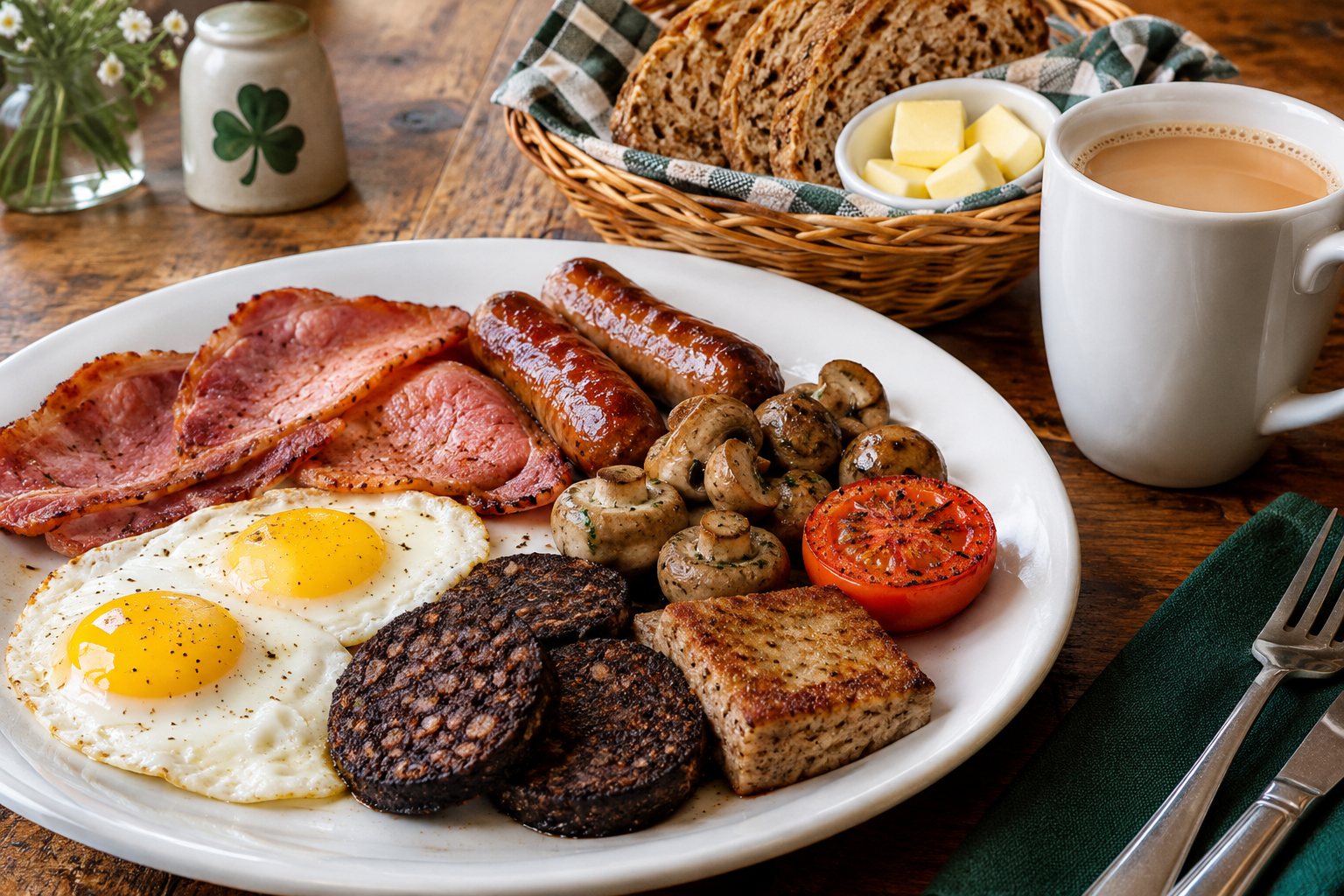
If you have watched MobLand, the Paramount+ crime drama about the Harrigan family, you may have noticed that when trouble arrives, the matriarch has a particular answer to it. Maeve Harrigan, played by Dame Helen Mirren, reaches for the frying pan. A full Irish breakfast, with all the trimmings, is her idea of what a family needs after a bad night. The English, by comparison, are left looking at a rather pale plate.
It is a very good piece of character shorthand, and it works because it is true to something real. For the Irish at home and abroad, a cooked breakfast is not just food. It is hospitality, comfort and a bit of a boast. So what exactly is on the plate, and how does it stand up against the rest of the world's breakfast tables?
What is actually on the plate
There is no official recipe, and every household and B&B has its own view. But the core is well agreed: rashers (Irish back bacon, cut from the cured pork loin), pork sausages, fried eggs, tomatoes and mushrooms, with tea to go with it.
Then come the two things that mark it out. First, the puddings: black pudding, made with blood, and white pudding, which has none and is typically built on oatmeal or barley, suet and breadcrumbs. Second, the bread: brown soda bread, or in some places fried potato farls or boxty, the potato pancake.
Up north, the Ulster fry keeps its own rules. Soda farls and potato bread are the stars, and purists will tell you that only what can be fried in lard belongs. Beans are a hot topic, and the Ulster Fry World Championships, first held in Donaghadee, Co. Down, in 2023, specify bacon, eggs, sausage, soda bread and potato bread. Avocado, puddings and French toast are not allowed. And across the Republic, the humbler cousin, the breakfast roll, is served in a demi baguette and sold in petrol stations and corner shops, so it can be eaten on the way to school or work.
Darina Allen of the Ballymaloe Cookery School in Co. Cork, as reported by the Philadelphia Inquirer, is clear that ingredient quality is what separates an excellent full Irish from a mediocre one, and that a good one will keep you full into the evening. Charles Campion, the food writer and MasterChef judge, has gone further on the northern version, calling the Ulster fry "probably the best breakfast in the world", according to Food NI.
Where it came from
The full Irish began as a working meal. It fed farmers, miners and other labourers who needed fuel for a long day outdoors. Today it is more often a weekend treat, a Sunday indulgence or the centrepiece of a B&B stay, which is a large part of why it holds such a place in the memory of people who have left.
Versus the full English
The two are close relatives, and the family argument is a friendly one. Both share bacon, sausages, eggs, tomatoes and mushrooms, and baked beans are common to the English plate and many northern Irish ones. The large cooked breakfast became widespread in Victorian Britain, reached its height in Edwardian times, and fell away after the Second World War, becoming an occasional meal rather than a daily one.
The differences are in the detail. A full Irish normally brings white pudding and soda or potato bread, where a full English more often has fried bread, and perhaps black pudding only in certain regions. If you ask an Irish cook, the extras are the whole point.
Versus Scottish porridge
Porridge is the quieter rival, and the Scots take it seriously. The World Porridge Making Championship has been held in Carrbridge, in the Cairngorms, since 1994, and its top prize, the Golden Spurtle, goes to the best traditional porridge, made with nothing but oatmeal, water and salt. The Irish are not strangers to oats either: it is oatmeal that gives white pudding its character. And nutritionally, porridge has real science behind it. In 2010 the European Food Safety Authority accepted that oat beta-glucan lowers blood cholesterol, with a health claim requiring at least 3 grams a day.
Versus the continental
The "continental breakfast" got its name in the nineteenth century, when British travellers used "the continent" to mean mainland Europe. It meant something light, a pastry or bread and coffee, as against the heavy meat-and-beans English meal. American hotels later adopted the name to signal that they would not be serving the heavy version. It is quick, cheap to serve and easy to keep, which is much of why it has lasted, but nobody has ever called it a hug on a plate.
Versus grits
Across the Atlantic, grits are the South's answer, and they have deep roots. Native Americans were boiling ground corn long before Europeans arrived. An English explorer with Sir Walter Raleigh's expedition near Roanoke described the dish in 1584, and Jamestown's settlers were taught to make it in 1607. South Carolina made grits its official state food in 1976, and shrimp and grits is now a classic. Like the Irish fry, grits are plain at heart and serve as a base for whatever the cook has to hand.
The nutrition question
Here is the honest part. Rashers, sausages and puddings are processed or cured meats, and in 2015 the World Health Organization's cancer agency, the IARC, classed processed meat as carcinogenic to humans, with an estimated 18 per cent higher risk of bowel cancer for every 50 grams eaten daily. Reporting at the time stressed that the classification reflects how strong the evidence is, not how big the risk is. The absolute figures are modest, and cooking method matters too, with high-temperature frying and grilling producing the most suspect compounds.
Irish commentators at the time reached for the old rule of moderation: a full Irish now and again is a very different matter from one every morning. If you want to tilt the plate, cook the rashers and sausages gently rather than at a high heat until charred, poach rather than fry the eggs, dry-fry the mushrooms, and put the brown soda bread to work. Or save the whole plate for the weekend, which is what most Irish households already do.
So, is it the best?
It is hard to say it is the healthiest, and a hotel's muffin will always be quicker. But as a breakfast with a story, one that comes with a place, a family and a welcome attached, the Irish fry takes some beating. Even Maeve Harrigan, who is hardly sentimental, seems to know it.
Over to you
We would love to hear from Irish and international chefs, cooks and nutritionists on this one. What do you put on a proper fry, what do you leave off, and how does it compare with the best breakfast from your own country? And for the diaspora: where in the world have you found a breakfast that tastes like home? Tell us through our contact page and we will feature the best answers in a follow-up.
Sources: Wikipedia, "Full breakfast"; Philadelphia Inquirer; Food NI; World Porridge Making Championship; EFSA; CBC on the IARC report; Culture Trip on grits; Mental Floss on the continental breakfast.